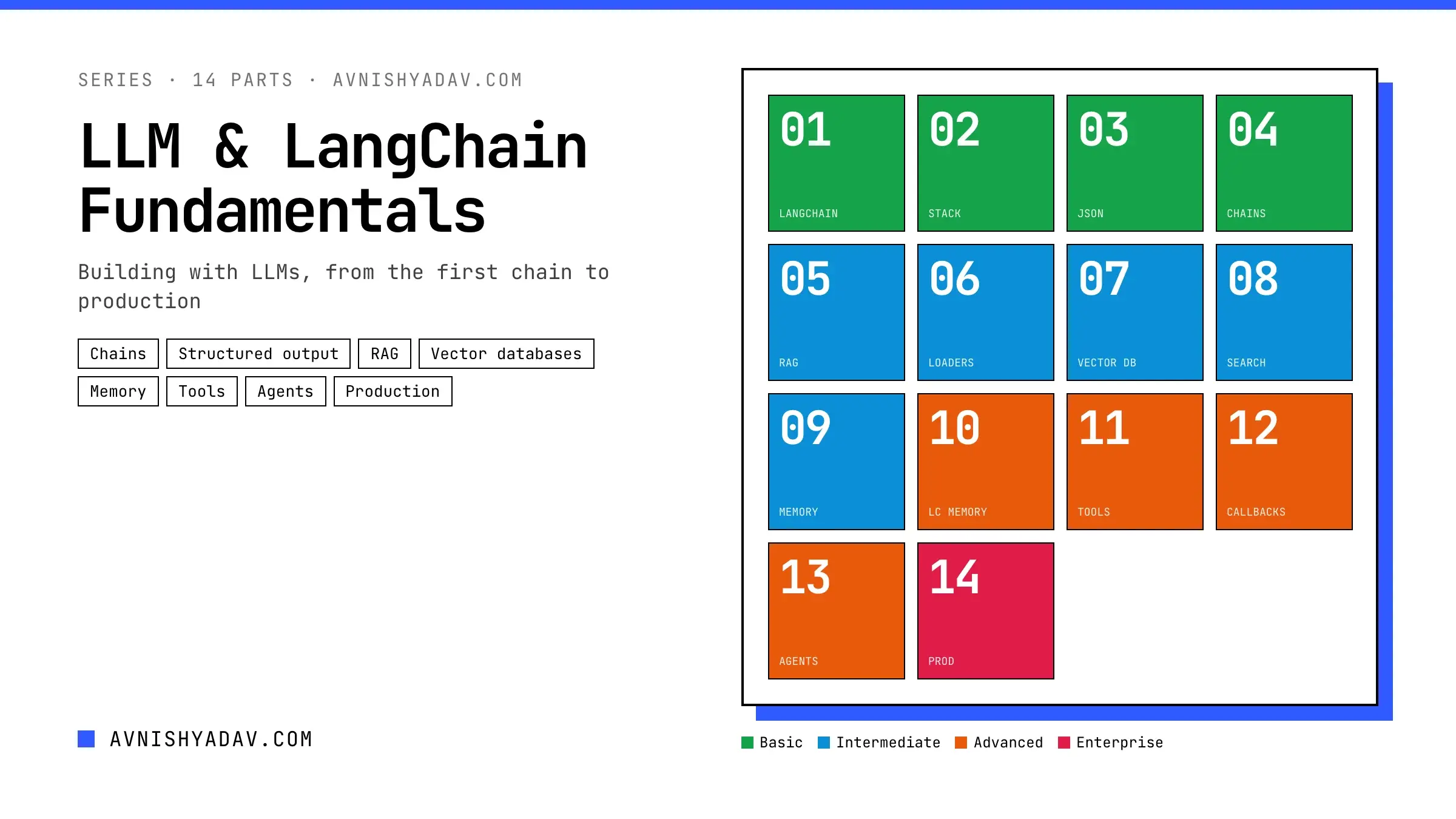
LLM & LangChain Fundamentals
Building with LLMs in learning order: what LangChain is and when to write your own code, structured output, chains, RAG with document loaders and vector databases, memory, custom tools and callbacks, autonomous agents, then deploying to production.
What Is LangChain? When to Use It and When to Write Your Own Code
What LangChain 1.x gives you today (create_agent, middleware, a standard model interface) and a plain framework for deciding between it and your own code.
02 · BlogLangChain vs. LlamaIndex vs. Vanilla: The Builder's Stack Selection Matrix
Pick between LangChain (with LangGraph), LlamaIndex and plain provider SDKs by asking where your app's complexity lives. Includes a three-question flowchart and starter folder layouts.
03 · BlogStructured JSON Output from LLMs: Schema Injection, Pydantic and Retry Loops
Get reliable JSON from an LLM: put the schema in the prompt, use structured outputs with a Pydantic model, and add a retry loop that sends errors back.
04 · BlogBuilding Your First LLM Chain: A Developer's Guide to Sequential Logic
Build a two-step LLM chain in Python with LangChain's pipe syntax: one prompt picks an angle, the next writes the post. Tested with a fake model, no real API key needed.
05 · BlogBuilding Your First RAG Pipeline: A Developer’s Guide to Context-Aware AI
Build a working RAG pipeline in Python: load a PDF, split it into chunks, store embeddings in Chroma, answer from the retrieved text, and measure whether retrieval finds the right chunk.
06 · BlogBuilding Robust RAG Pipelines: A Deep Dive into LangChain Document Loaders
Load PDFs, CSVs, web pages and whole folders into LangChain Documents, keep the metadata you need for citations, and split the text into chunks for a RAG pipeline.
07 · BlogStop Overthinking Vector Databases: A Builder’s Decision Framework
Choose a vector database with three questions: is your data relational, who runs the infrastructure, and how many vectors you store. Includes HNSW vs IVF basics and a pgvector setup in Python.
08 · BlogBuilding Long-Term Memory: Setting Up Vector Databases for Semantic Search in LangChain
Split your text, embed it, store it in Chroma and search it by meaning with LangChain. Then add MMR for varied results, a Pinecone option and a small RAG chain.
09 · BlogFrom Chatbot to Agent: The Engineer's Guide to LLM Memory Systems
How agent memory works, in plain Python: a rolling window for the current chat, a running summary, and a vector store for facts, with recency weighting and a fake-model test.
10 · BlogBuilding State: A Deep Dive into LangChain Memory for Conversational AI
Add memory to a LangChain chatbot the current way: a checkpointer for chat history, a trimming window, SummarizationMiddleware and the Store API, all tested with a fake model.
11 · BlogBeyond Built-ins: Architecting Custom Tools in LangChain
Build custom LangChain tools two ways, the @tool decorator and a BaseTool subclass with a Pydantic schema, then handle tool errors so the agent can fix its own mistakes.
12 · BlogUnmasking the Black Box: Mastering LangChain Callbacks for Debugging
See inside a LangChain agent with callbacks: print every step, write a custom audit handler, count tokens, avoid async mistakes and send traces to LangSmith. Handlers tested with a fake model.
13 · BlogArchitecting Autonomous Agents: A Builder’s Guide to Complex Workflows
How an AI agent loops through thought, tool call and observation, how to build one with LangChain's create_agent, and the guardrails that stop loops, bad arguments and context overflow.
14 · BlogBest Practices for Deploying LangChain Apps to Production
Serving, streaming, per-user state, caching, tracing, evals, secrets and timeouts: a checklist for moving a LangChain 1.x agent out of the notebook.